As investigations over Tauranga City Council's operations during last month's weather event begin, Whakatāne District Council is taking time to reflect on it's own operation.
Whakatāne Mayor Nándor Tánczos said he is appreciative of the efforts of local Councils, Civil Defence and information channels that helped make people in the Bay of Plenty aware of what was coming in last months storm.
Original predictions were that it would be much worse for the Eastern Bay, but the Western Bay bore the brunt Tánczos said.
“I think we were extremely lucky. We dodged a bullet again, just like we did the last time.”
“And our hearts go out to them and those communities who you're dealing with the aftermath of that. Very mindful that things could have been a whole lot worse.”
Now, Whakatāne District Council is reflecting on its own systems and preemptive works for future events said Tánczos.
The Government currently allows a removal of rates capping to help provide aid for recovery, but he said, “one of the things that I think we need to do is we need to actually spend the money preemptively.”
He said it is getting too expensive to react to weather events, so the Council is looking at preventative measures to save money and human tragedy too.
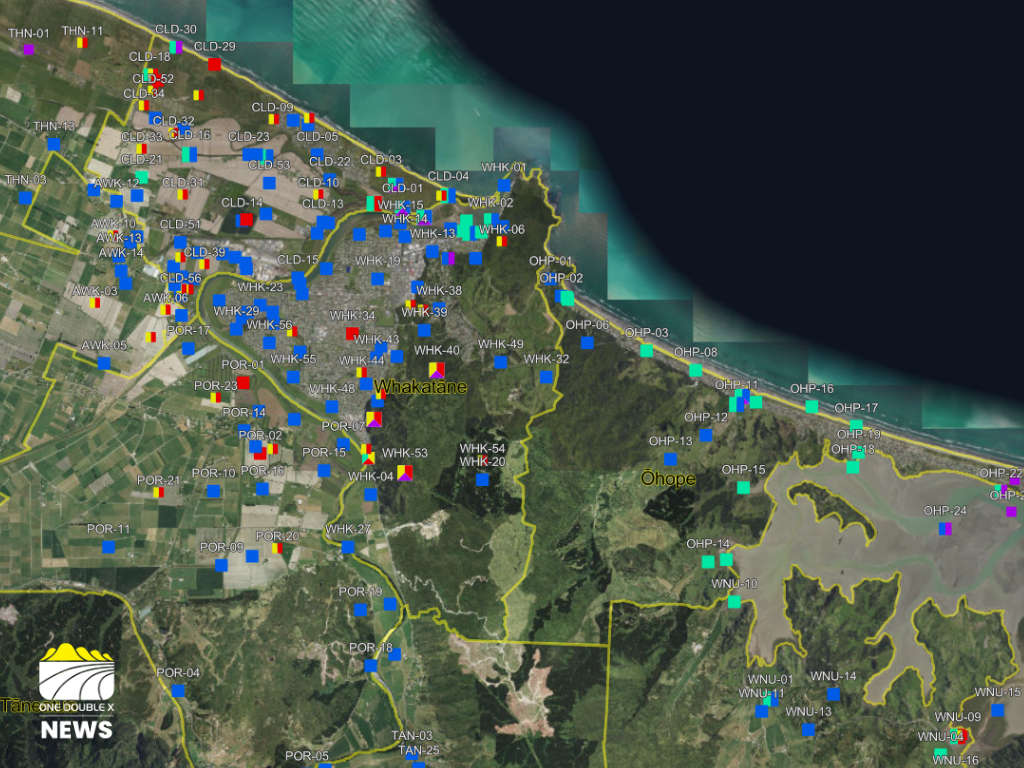
One major piece of work for this is looking at hazard mapping.
Making sure the mapping is accurate and informing homeowners is a key focus, he said.
“We need to go well, is our hazard mapping in the right place? Is it comprehensive? Are we providing information to landowners?”
The outcomes of the hazard mapping review will be available through the Land Information New Zealand data.
He said there would be a reassessment of response systems with any changes to the hazard map.
Hazard mapping will help identify where potential slips could occur.
The steep terrain and unsteady ground make roads around Whakatāne vulnerable which can lead to road closures and isolation, said Tánczos.
“We need to make sure that the infrastructure is robust which means it's strong and able to withstand these shocks and put in place the right treatments to make them less vulnerable to slips and slides.”
He points to Waioweka Gorge and the East Cape as an example of this and added Whakatāne has been in that position in the past.
To prevent this, on top of having roads able to withstand weather, road resilience is important he stressed.
Having a two laned and sealed Bridge at Pekatahi will help give Whakatāne residents an alternate route if needed and prevent future isolation for the township he said.
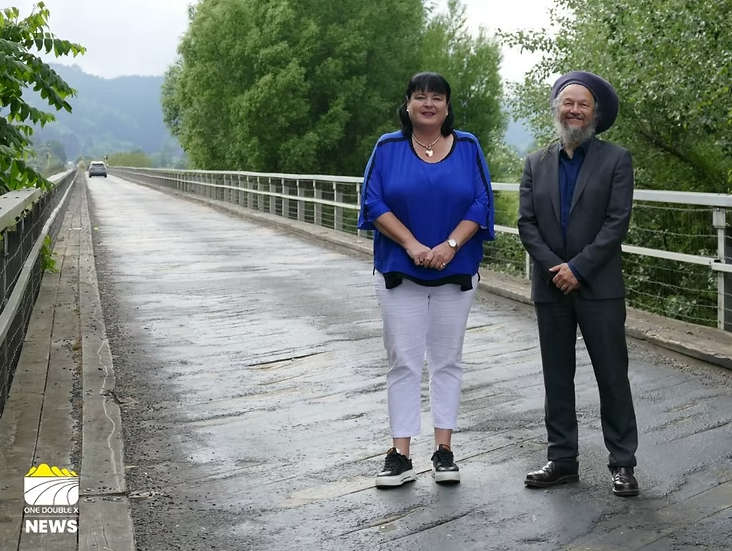
East Coast MP Dana Kirkpatrick and Whakatāne Mayor Nándor Tánczos on Pekatahi Bridge
Areas not in slip zones have their own issues as well.
The area in and around Whakatāne is low lying and in parts reclaimed wetland, which makes the area flood prone.
Mayor Tánczos said one way to help prevent damage is the flood wall installed by the Bay of Plenty Regional Council, as well as the pump stations the District Council has been working on.
"We've spent quite a lot of money over the last few years on getting the pump stations right.”
He also expressed that stormwater drainage is an important system to get right.
Concrete pipes have posed issues in the past, by letting out large amounts of water at once, so they are looking at ecosystem-based options he said.
“There's these concepts of sponge cities and things like that that you've seen from overseas and we're adapting some of those ideas instead of just trying to pipe everything through concrete pipes, because they have real vulnerabilities.”
He said the Council has begun using wetland like or open systems where wetlands absorb the water and slowly release the water, eliminating large rushes of water that the land cannot handle.
In some places “we're allowing the flood to happen and then drain away," he added.
Weather events are worsening and happening more frequently, which Councils need to prepare for he said.
Looking at infrastructure, slips and flooding alongside prepared emergency teams and accurate information systems will make sure Council are prepared for the next event.
He urges people to acknowledge the part Aotearoa is playing in climate change “because it's countries like us that suffer the result, island nations in the pacific, small ones but ourselves as well."
"We bear the brunt of climate change.”
 Bay of Plenty Councils Explore Shared Water Services Option
 Ōpape Beach Road Emergency Work Complete
 Wetland Restoration Marks Milestone for Waihī Estuary
 New Tool Maps Climate Risks Across Whakatāne District
 Community Reference Group for Awakeri Development Opens