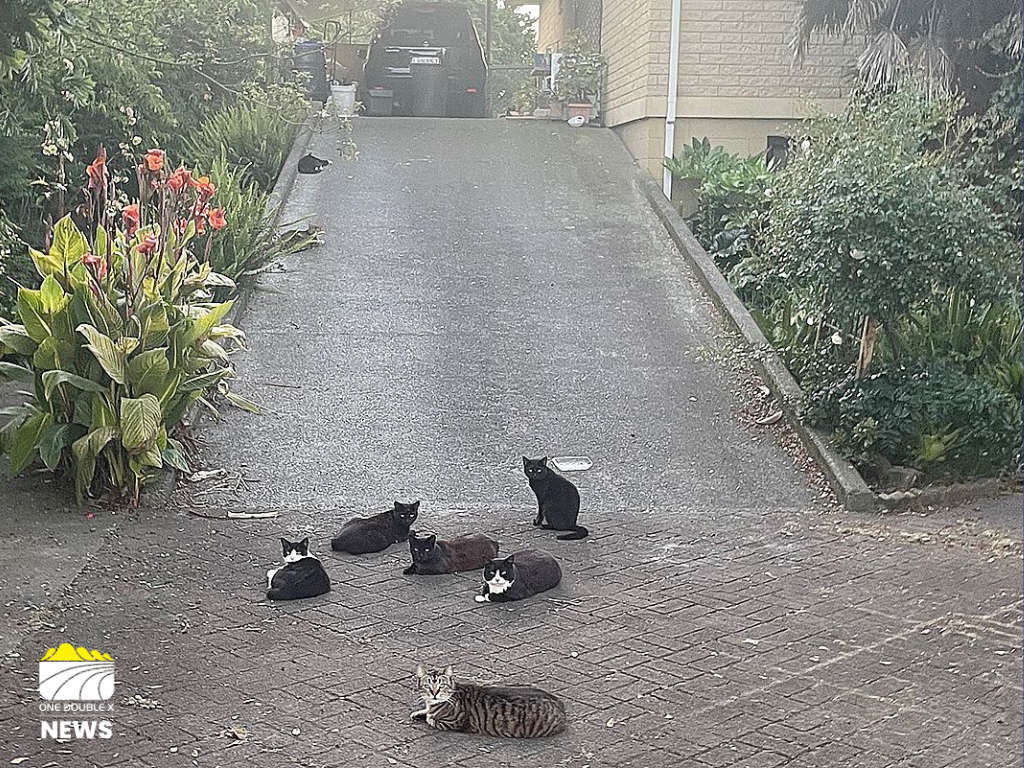
The Ōpōtiki community are facing an abundance of stray cats roaming the streets.
Speaking after residents raised concerns at a council meeting, Mayor David Moore said problems in town are “cats that someone’s either abandoned or neglected”.
“Unfortunately, they are being fed, and they’re hanging around and causing all sorts of problems,” he said. “The core issue is people are just not responsible with their cats.”
He explained that many owners fail to de-sex their pets, contributing to breeding and an increase in roaming cats.
While acknowledging the work of local rescue volunteers, he said the issue is particularly rife in Ōpōtiki.
“Our council is responsible for about 25% of the Bay of Plenty’s landmass, so the feral cats is a different problem to one in town,” she said. “This current issue is these poor people having to put up with other people’s cats that are either being abandoned or they’ve just bred. These aren’t feral cats from the bush - that’s another issue.”
Moore said cat control would likely require government involvement and legislation changes, highlighting existing laws such as the Dog Control Act 1996 and the Wild Animal Control Act 1977 as examples of existing legislation that may need revisiting.
“There is no by-law regarding cats,” he said.
“And if you do have a by-law, how do you actually enforce it? It’s very difficult to tell which is a wild cat and which is a cat that’s come over from the neighbours.”
Moore explained that the introduction and enforcement of a cat by-law would come at a cost to ratepayers.
He said the council can speak to residents who may be feeding the cats, “but that's about it at the moment.”
“If someone's trying to be kind, feeding them, they happen to be congregating around where they're being fed, and they're causing a real issue for these poor residents.”
Moore stressed that it’s “not just a council problem,” it is “a community problem.”
“It’s just not responsible to have cats and then, when you get sick of them, just abandon them so they become someone else’s problem.”
“The council just can’t be the police going around all the time. As a community, you have to take responsibility.”
Local charity the Ōpōtiki Society for the Care of Animals, more commonly known as OSCA, are doing its bit to ease the burden on residents.
Centre manager Kathleen Young, who has worked at OSCA for 20 years, said their concern is that these cats have not been de-sexed.
“Our main objective is de-sexing and microchipping and re-homing a cat that's had a vaccination and set up with good worm and flea treatment,” she said
Young explains that a cat can breed up to maybe, definitely two to maybe three times a year if given the opportunity, “so numbers just multiply.”
She said the public doesn’t always see the full scale of the issue.
“People only see their little picture, whereas we see the whole picture,” she said.
She acknowledges that while de-sexing is “the most effective way” to curb this issue, there is a cost barrier.
De-sexing is not the only solution OSCA believes may help the problem.
Young says de-sexing is the most important, but microchipping is up there as well.”
“So you can identify a cat, return it to the owner if it was microchipped.
She said they encourage people who are getting their cats de-sexed to get them microchipped as well.
OSCA do have humane cat traps available to help curb the issue when it gets particularly bad.
She said they lent a trap to one resident who had a particularly large congregation of strays on his property.
A few of the cats were “relatively friendly, and we were able to put them through our homing system and have them adopted,” Young explained.
“Generally, the purpose of a trap is [to catch] the stray, because a stray isn’t necessarily a friendly cat, and they can be equally not nice if they haven’t been handled particularly [well] much.”
She said they provide information to people on how to correctly operate these traps to ensure the animal is treated most humanely.
“A cat in its natural habitat or natural way it operates is to wander around. Obviously, a cat is there to reproduce, and so between a male and a female, they’re both seeking out mates.”
“It comes back to that word of de-sexing again. So if they’re de-sexed they obviously won’t go out mating, and they generally become a much healthier cat when that’s done.” Young further highlights.
OSCA urge those unable to care for their animals to seek help early.
“If they can’t look after them, can they bring them to the centre and we’ll assess them to make sure that they’re homeable and then put them through our system for rehoming,” she said.
Young agrees with Mayor David Moore on the difficulties that come with enforcing cat control.
“To me, to get legislation through, I think it could be in a very hard bucket because if you follow the Animal Welfare Act, any stray animal must be held for seven days to find a genuine owner. So who might that person be, and who might that place be that would hold un-microchipped cats for seven days? That’s a very logistical problem, and as far as a council goes, of course, they can make the best recommendation to de-sex and microchip and maybe keep your numbers low, but unless they’re getting monetary funds through ratepayers, it won’t happen for cats.”
She returns to the same solution: de-sexing.
“I think if we can manage the numbers and keep giving incentives and encouragement for people to de-sex their companion animals, both cats and dogs, because the problem lies with both within our community, the problem is always going to be existing, and it’s always been existing,” Young explains.
After introducing their de-sexing program, offering discounts on de-sexing cats, she has noticed a decrease in stray cats coming to them.
“We have, I think, 20 in the centre at the moment, but this time of year we would have been incoming around 40 or 50.”
She said it is a relief to have a bit of a break, “but you can’t let up, you can’t stop.”
“We’ve just got to keep encouraging people and educating people that de-sexing is the way to go.”
 Two Identified After Puppies Drowned in Whakatāne River Incident
 Rising Fuel Costs Prompt Call for Smarter Spending
 Kakahoroa Drive Works to Begin on Underground Pump Station
 Uncertainty Remains Over Steel Plates for Pekatahi Bridge