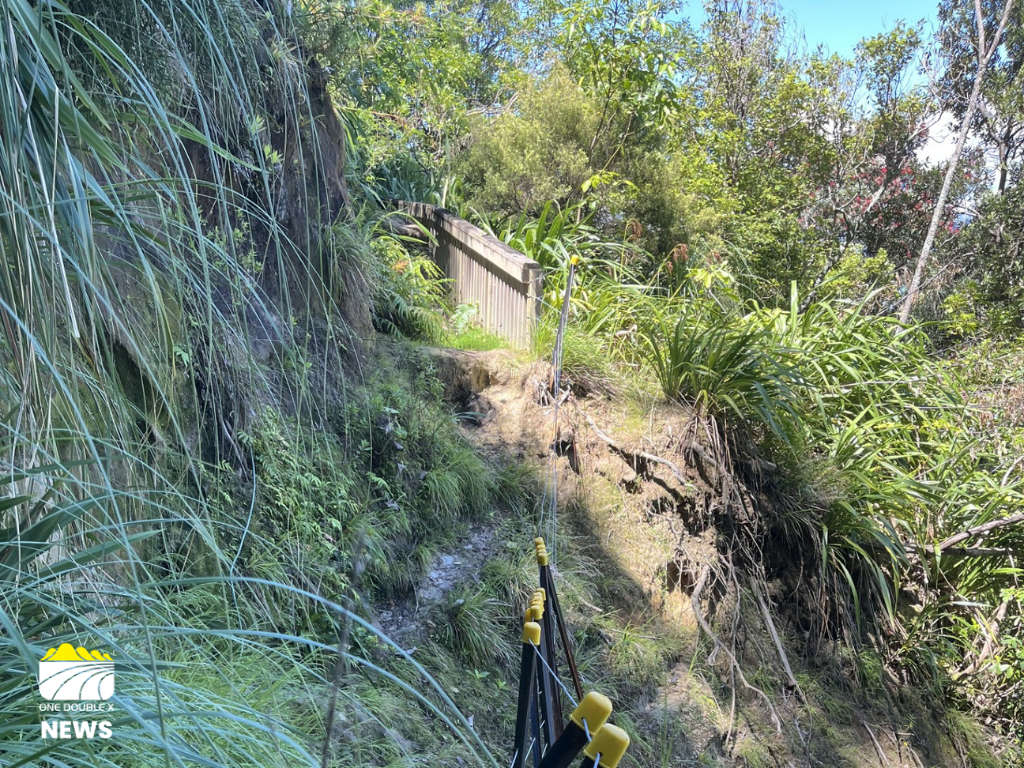
Whakatāne District Council has agreed in principle to work alongside Toi's Track Restoration Trust to explore restoring the Ngā Tapuwae o Toi Walkway, marking what both sides describe as an important step toward reopening the iconic coastal track.
The unanimous decision, made at Thursday's Ordinary Council meeting, establishes a joint project group to assess whether restoring the walkway is safe, feasible and sustainable after major slips forced its closure.
Mayor Nándor Tánczos said the decision reflects a new approach to working with the community.
"Ngā Tapuwae o Toi holds a special place in the hearts of many people across our district and beyond. We know how deeply our people care about this track," he said.
"Nobody is pretending this will be easy. There are challenges to work through, technical questions to answer and risks to understand. But what we have today is a willing community partner, a willing Council, and a shared desire to thoroughly test what is possible."
Council has committed up to $250,000 from its 2026/27 Annual Plan contingency fund for technical assessments, specialist advice and project resources.
It will also seek external funding, obtain legal advice on residual liability risks and consider long-term maintenance funding through the 2027-37 Long Term Plan.
However, while welcoming the decision, Toi's Track Restoration Trust said it remains concerned some conditions attached to Council's approval could create barriers to progressing the project.
Trustee Angus Robson said the announcement appeared positive at first glance, but the detail raised concerns for the Trust.
"It looks like a victory if you only read the headline, and then you dig into the detail," he said.
"We feel like we're being set up to fail by being forced to conform to something that's impossible to conform to, and that no one else in the country was interested in trying to conform to."
Robson said the Trust's main concern is that Council's approval remains tied to meeting requirements outlined in its original request for proposals (RFP), which went beyond the Trust's proposal to repair the two major slip sites that forced the walkway's closure.
He said those additional requirements included maintaining the full track for 10 years and demonstrating how that work would be funded.
"We put our bid in to fix the two slips... and somehow it turned into this giant thing, which we don't understand how or why."
Robson said the Trust wanted a more collaborative approach with Council, arguing volunteers had not been involved in shaping the original process.
"Our first request, and it goes back to the very start of any of this, is that we work collaboratively," he said.
"We haven't honestly seen a single bit of collaborative work."
He said the Trust was not given an opportunity to clarify aspects of its proposal before Council identified gaps between the two positions.
"We were never asked to clarify anything. We didn't get the chance."
Robson said the Trust believed many of the issues identified related to differences in expectations rather than a failure to provide information.
"The way forward is to get rid of all of that nonsense of sticking it to us and saying this is how it'll be, and sitting down with us, with a structured way of working with volunteers," he said.
"Let's sit down and talk about it... and work through the things like normal people in a room."
Robson welcomed Council's commitment to seek legal advice on residual health and safety obligations but said the Trust wanted that advice to come from a recognised specialist.
"What we've asked for multiple, multiple times is for the council to clear this up with a legal opinion," he said.
"We're only going to accept the proper opinion of a specialist in this area."
He said the Trust also supported having an independent person involved to help both parties navigate disagreements as the project progresses.
"We think we need an independent person... that can call it and make sure that we stay on track."
Despite its concerns, Robson said the Trust remained committed to finding a way forward.
"We live in hope," he said.
"We're gonna keep pushing."
"But we're not jumping for joy at the resolution by the council yesterday because it hasn't played out yet against the conditions."
Council said its decision recognises both the community's desire to see the track reopened and the significant engineering, legal and safety challenges involved.
General Manager Community Experience Alexandra Pickles said independent technical advice has documented the risks at the site.
"What today's decision does is acknowledge both realities – the risks that exist, and the overwhelming community desire to see this track restored," she said.
"Rather than simply closing the door on that possibility, the Council has chosen to work constructively with the Trust to better understand whether those risks can be appropriately managed and whether a viable pathway forward exists."
Robson said the Trust also wants Council to seek advice from a specialist health and safety lawyer on residual liability obligations and is calling for an independent facilitator to help both parties work through any disagreements as the project progresses.
Both Council and the Trust said there is significant work ahead before any decision can be made on whether the walkway can be safely restored and reopened.
 Police Crack Down on New Gang Chapters in Ōpōtiki
 Under the House to the Try Line: Ruby and Her 11 Pups Seek Forever Homes
 Eastern Bay Local Government Future Left in Limbo After Head Start Decision Delayed
 Hillcrest Road Closures Scheduled for Friday