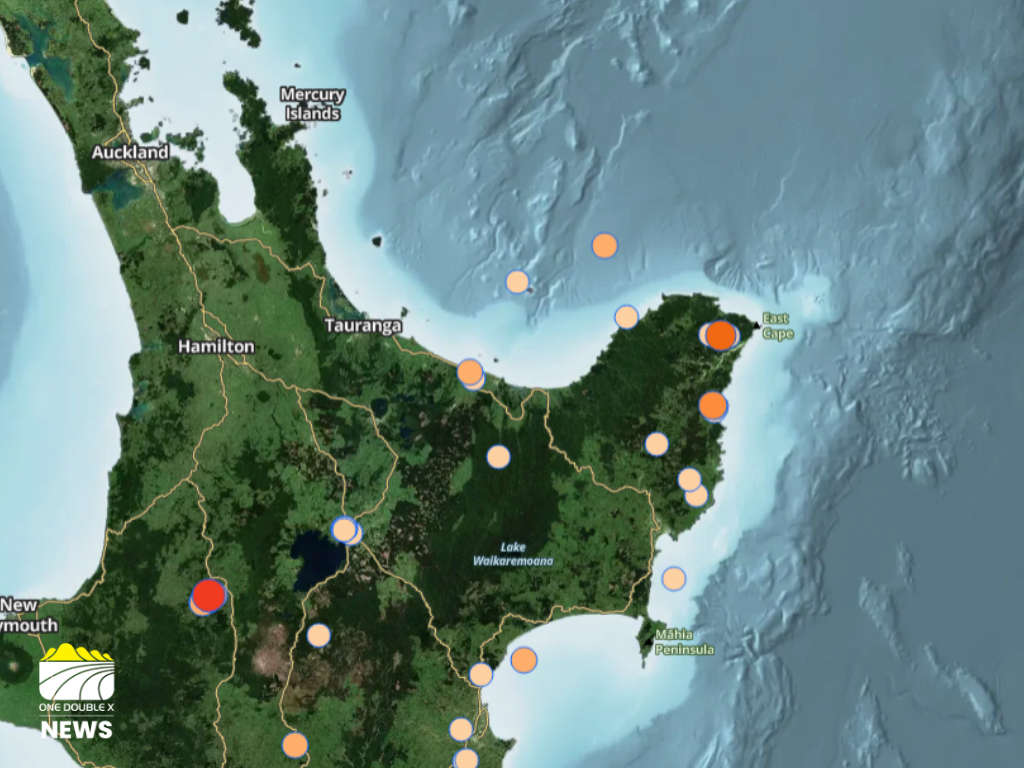
A cluster of earthquakes across the Bay of Plenty and East Cape is not a sign that a larger quake is on its way, but it is a reminder that the region remains exposed to serious seismic risk, Earth Sciences New Zealand says.
Seismic duty officer Elisabetta D'Anastasio said there is currently no reason to think the recent activity indicates an impending major earthquake.
Three earthquakes of magnitude 4 or greater have struck the wider area in recent weeks, including a magnitude 4.7 quake off the coast of Waihau Bay on Monday and a shallow magnitude 4.1 earthquake near Edgecumbe on Tuesday evening.
D'Anastasio said the earthquakes are part of the normal tectonic activity of a country that sits on one of the world's most active seismic boundaries.
"We live on a shaky island," she said.
D'Anastasio explained that New Zealand typically experiences around 40 magnitude 5 or greater earthquakes a year, although the number varies.
"The reason why we are observing more events than usual is probably coincidental."
She said the recent activity should be viewed in the context of a much longer geological timescale.
"We are only observing a very small snapshot of the phenomena that take thousands and thousands of years to build up. There's no specific things to be concerned about right now."
The three earthquakes stem from the same broader geological setting, D'Anastasio said.
"They are all caused by the same underlying mechanism, which is the Australian plate that is subducting below the Pacific plate in the region."
The area from Whakatāne to Tongariro National Park is also part of a rift zone, where the crust above the subducting plate is stretching.
"So it's forming the volcanoes and the beautiful landscape that we have," she said.
The latest earthquakes also demonstrate why magnitude alone does not tell the whole story.
The magnitude 4.1 earthquake near Edgecumbe was relatively shallow, with GeoNet recording it at a depth of 12km, making the shaking particularly noticeable for people close to the source.
D'Anastasio said the depth of an earthquake can have a major influence on how widely it is felt.
The magnitude 4.7 earthquake near Te Araroa was a deeper event, but was widely felt because its energy travelled through the subducting plate.
She said Tuesday's shallow quake would have been "quite a good shake" for those closest to the epicentre.
The earthquakes have also raised questions about whether they are connected to activity at Whakaari/White Island.
D'Anastasio said there is no evidence of a direct link.
"As far as we know, we don't see any direct ties between Whakaari activity and this event [on Tuesday], or the seismicity ongoing."
Volcanic activity has remained at relatively low levels since Whakaari's most recent eruption in March.
But that does not mean the risk can be ignored.
D'Anastasio said the key message for Bay of Plenty residents is that scientists cannot use a run of moderate earthquakes to predict when a damaging earthquake will happen.
"We can expect those large events anytime, independently of how many events we see," she said.
"Large events that are dangerous can really happen anytime. And it's very important to always be prepared."
For Bay of Plenty residents, the advice is straightforward: drop, cover and hold.
Reports from previous earthquakes have shown that people often instinctively move during strong shaking, heading for a doorframe or trying to reach loved ones, but D'Anastasio said that instinct should be resisted.
"Many go under a doorframe or move to see if their loved ones were safe. And I would do the same… but the important thing is drop, cover and hold."
"If you're in bed and it happened in the evening, just stay in bed and cover your head with a pillow.”
She urged people to practise the response with their families.
"Teach your whānau and kids to do the same and to be safe and always be prepared."
For coastal communities, there is another critical warning: a long or strong earthquake is itself a natural tsunami warning, and people should not wait for an official alert before acting.
"People [who] live close to a coast... if you feel the long or very strong shaking, just run. If you're outside after the shaking, just go towards higher ground to be safe," D'Anastasio said.
The risk is particularly important for the Bay of Plenty because tsunamis generated in the Kermadec region could pose a serious threat without necessarily producing extremely strong shaking locally.
Recent destructive earthquakes overseas are another reminder of the importance of being prepared, but D'Anastasio said there is no known direct connection between earthquakes in Japan, South America and New Zealand.
"The main connection, again at a larger scale, is that we all live around the Pacific Ring of Fire," she said.
While the recent earthquakes may not be a warning that a bigger one is coming, they are a reminder that damaging earthquakes can happen without warning.
D'Anastasio said scientists around the country were continuing to monitor the activity around the clock.
"We have many seismologists that study the phenomenon, and every earthquake is a good reminder, and it's also a good opportunity for us to improve our understanding."
For residents, the message is simple: rather than trying to predict what the next shake might mean, be prepared for it.
 Police Crack Down on New Gang Chapters in Ōpōtiki
 Under the House to the Try Line: Ruby and Her 11 Pups Seek Forever Homes
 Eastern Bay Local Government Future Left in Limbo After Head Start Decision Delayed
 Hillcrest Road Closures Scheduled for Friday