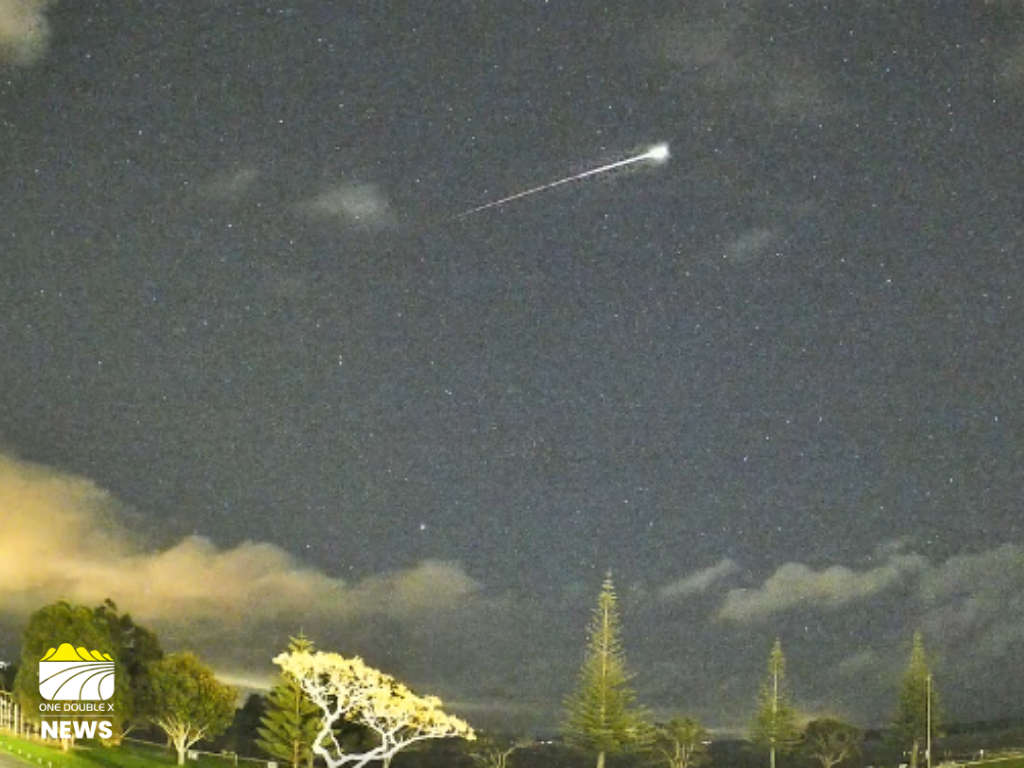
A spectacular fireball streaked across the skies above the Bay of Plenty on Sunday night, with residents from around the region reporting seeing the bright object as it travelled across the upper North Island.
The event happened at about 7.43pm on Sunday, August 30, with sightings reported from areas including Ōpōtiki, Te Puke and Rotorua.
Fireballs Aotearoa director Steve Wyn-Harris says the organisation knew about the event within minutes, thanks to eyewitness reports and its nationwide network of meteor cameras.
The meteoroid entered Earth's atmosphere at around 90 kilometres above the surface, travelling at approximately 18 kilometres per second.
"Ten seconds later, it's now doing about five kilometres a second," Wyn-Harris said.
By that point, the fireball was around 30 kilometres above Earth, well north of Tauranga and southeast of Whitianga.
Wyn-Harris says the object was likely destroyed before it could reach the lower atmosphere.
"It probably hasn't got low enough or slow enough to drop rocks, meteorites," he said.
While fireballs are spectacular to witness, the phenomenon itself is not particularly unusual.
Wyn-Harris says hundreds, and sometimes thousands, of smaller pieces of space debris enter Earth's atmosphere every night. Most are tiny particles of dust and debris that create the familiar "shooting stars".
The larger objects are known as fireballs, and they are of particular interest to Fireballs Aotearoa because they may survive their journey through the atmosphere and leave meteorites on the ground.
Fireballs Aotearoa operates a growing network of cameras around New Zealand to track these events and calculate their trajectories.
The data can help scientists determine where a meteorite may have landed.
The organisation has already successfully recovered meteorites in New Zealand, including the recently discovered Ruamāhanga meteorite, which became the country's 11th confirmed meteorite after fragments were recovered in the Wairarapa.
For Sunday's event, however, the calculated trajectory suggests any surviving fragments would have fallen into the ocean.
Freshly recovered meteorites can provide scientists with valuable information about the formation of the solar system, with these ancient rocks dating back around 4.5 billion years.
"We are made up of stardust ourselves," Wyn-Harris said.
"So we're made of the same material, these same atoms from the same event four and a half billion years ago."
 Car and Train Crash in Paengaroa Leads to Homicide Investigation in Kawerau
 El Niño Could Increase Wildfire Risk Across Eastern Bay
 Whakatāne Hospital Neonatal Unit to Expand Capacity