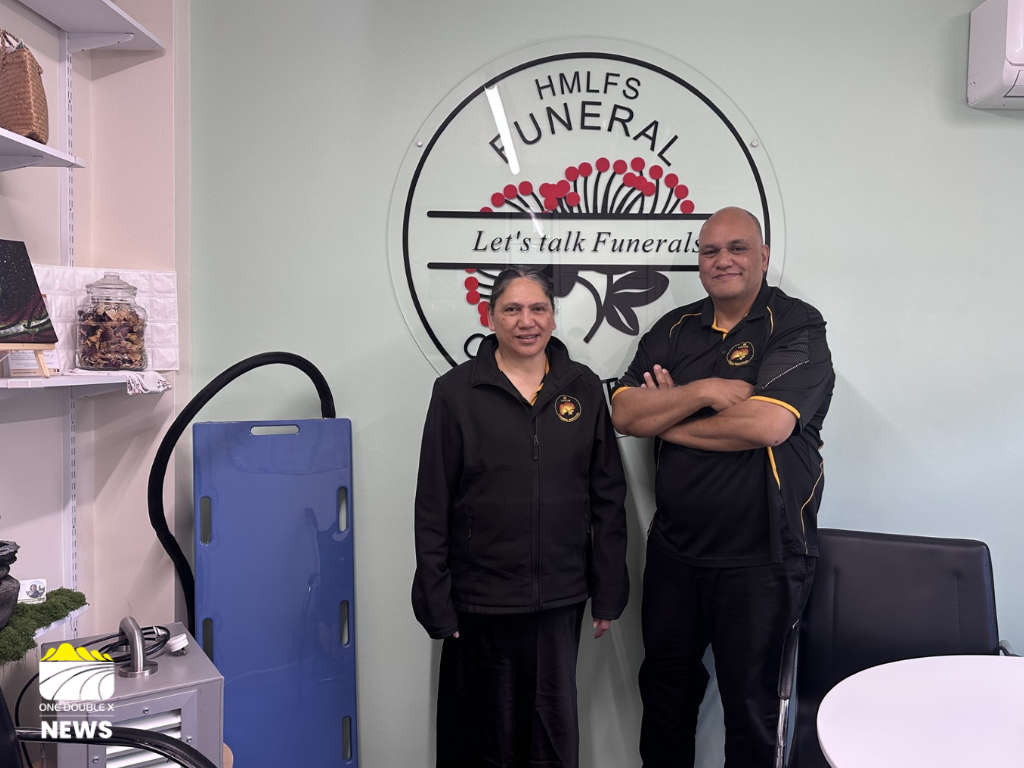
A Kawerau couple are challenging the traditional funeral model by helping whānau care for their loved ones themselves, with a focus on affordability, dignity, cultural connection and healing.
For many families, the death of a loved one comes with grief, shock and a long list of decisions that need to be made quickly.
But Hemi and Memory Mooney of HM Locum Funeral Services believe families should have more time, more information and, most importantly, more choice.
Their approach is simple: rather than immediately handing responsibility to a funeral home, they walk alongside whānau so they can understand the process and, where appropriate, take an active role in caring for their loved one.
That can include washing and dressing the tūpāpaku, making a base rather than buying an expensive casket, creating a harakeke wrap or shroud, completing paperwork, and preparing together for the funeral.
The couple said the work is about far more than saving money.
“It gives the family a choice,” Memory Mooney said.
“For me, what it'd been at the beginning is just giving people the right information so they can make informed decisions for themselves,” Hemi Mooney said.
Hemi Mooney has worked in the funeral industry since 2015 as a funeral director and embalmer.
It was while working at a local funeral home that he began questioning whether the conventional approach was working for everyone.
He recalls sitting with an elderly woman whose loved one had died and asking how she would pay for the funeral.
She was on a pension and planned to make repayments of $5 a week.
For him, the conversation was a turning point.
“When a person dies, you kind of get given the book,” he said.
“When you go for a car, you get to plan things out. You can say, OK, I can afford this much, but when a loved one dies, you have to come up with it.”
“For me, that kind of set something up inside me. I said, nah, this can't, it must be another way.”
He began researching alternative approaches, including ways Māori used to care for the dead and eventually started exploring how families could be supported in taking back some of that responsibility.
“In our culture, we like to stay with our loved one,” Memory Mooney said.
“This kind of mahi for families is actually giving them the mana back to be able to be in that position, to make those decisions and to do what they want to see and how they want to see their loved one cared for.”
The couple begin with one-on-one conversations, giving people information about what is possible before a death occurs.
Families can then decide whether they want to learn more, bring the wider whānau together, or take part in a weekend wānanga covering the process from beginning to end.
That preparation can be critical.
The couple said families are often frightened by changes that naturally happen to a body after death.
Without that knowledge, something as simple as a change in colour can cause panic and make families feel they need to rush into burial or cremation.
Their view is that families should understand those changes beforehand so they can make decisions calmly rather than from fear.
“If they're not aware of that, then it actually becomes something quite fearful,” Hemi Mooney said.
“If you haven't had those wānanga or those learnings, family will freak.”
“We're not just about, you know, let's organise how this is going to be paid,” he said.
“We're about the ones that get left behind. They're the ones that are going to be in more pain than the one that's gone.”
The Mooneys believe being involved in caring for a loved one can also become part of the grieving process.
They have seen young family members help make a harakeke wrap, only to realise afterwards that they had created something meaningful for the person they loved.
“Oh, I did that. I did that. I was a part of that, and that meant something to them,” Memory Mooney said.
“It’s a way that they can show their love for their loved one.”
“It’s as though the healing process is already starting for them, because they're involved in it,” she said.
They also believe preparation can prevent conflict within whānau.
When everyone understands the process and has an opportunity to discuss what they want beforehand, there is less chance of arguments and misunderstandings after a death.
The couple are not positioning their approach as a competition with other death care providers.
They acknowledge there are other groups doing similar work in the Eastern Bay of Plenty, and said the growing interest in natural death care is positive.
“It isn't a competition,” Memory Mooney said, “and it's not about the money, for me.”
Affordability matters, they said, but the bigger opportunity is giving families the knowledge and confidence to make their own decisions.
“It can be an advantage of being in a position where you know what's going on and you can follow this process with your family,” she said.
“It can be a beautiful thing. And you don't have to be afraid of it. And through that, you get healing.”
They believe that healing can extend beyond the immediate grieving process, bringing families back together and creating space for relationships to be restored.
“You get family members connecting,” Memory Mooney said.
“You know, relationships that have been broken off for whatever reasons, but they come together at death. And there can be healing in that.”
“Restoration of families coming together through this loss.”
For Hemi Mooney, that belief has also been shaped by what he has witnessed during his years in the funeral industry, including situations where families have become divided during the funeral process.
“When my wife is talking about healing, and that's what we see in this space,” he said.
“Families actually come in beforehand, and that's their preparing or pre-talking. It helps them to get into a space where all this negativity about the process, or anything about death, is kind of washed away over time.”
“It just gives them a bit of time to just focus on the loved one that's there rather than anything else.”
For the couple, death care is about giving whānau time, knowledge and the ability to remain connected to their loved one.
“It doesn't have to be just about the money,” Memory Mooney said.
“It can be a beautiful thing. And you don't have to be afraid of it.”
They want whānau to feel comfortable talking about death before they are forced to make decisions in the midst of grief.
“Try and break the fear of death being taboo, or death being tapu, and just come and knock on the door and say hi,” Hemi Mooney said.
 Police Investigating Following A Crash On State Highway 30 Last Night
 Caution Urged on State Highway 2 Near Matawai Amid Icy Conditions
 Pekatahi Bridge to Close Overnight for "Essential Bridge Maintenance" as Replacement Plans Progress
 Whakatāne District Council Retains FPP for 2028 and 2031 Elections