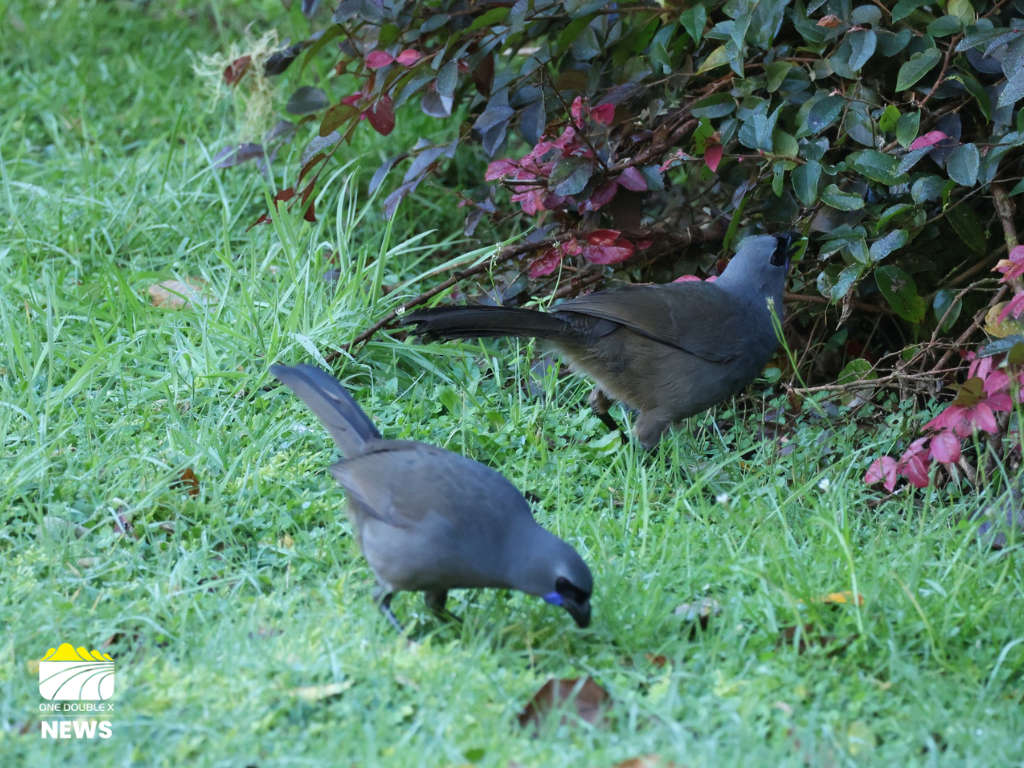
A small but significant recovery is underway for one of Aotearoa’s rarest native birds, thanks to decades of conservation work in the Eastern Bay of Plenty.
The kōkako population at Manawahe has climbed to about 30 birds, the highest it’s been in 20 years.
Wendy Montrose, Manawahe local and Manawahe Eco Trust trustee, said the increase follows targeted translocations aimed at boosting genetic diversity in what had been a struggling, isolated population.
“In 2019, we did a translocation of birds from Kaharoa, just out of Rotorua. So we brought six birds to Manawahe to increase the genetic diversity in our population,” Montrose said.
Further transfers followed soon after.
“So we did another translocation in 2020 or 21. And so all up, we brought 12 birds to Manawahe.”
She aid numbers have been “very gradually” rising.
A key turning point came from an unexpected pairing.
“One of the females from Kaharoa has consistently produced chicks from the very first season that she landed. She’s saved us, really.”
The bird’s original mate died shortly after relocation, likely due to stress, but in a rare twist, bonded with a local male.
“She hooked up with this local bird, and it just worked. So it’s been amazing since.”

Wendy Montrose lives in the conservation area of Manwahe, and hears the "special" kōkako song every day.
When Montrose first moved into the conservation area in 1995, she discovered “a very small population” of kōkako.
“We killed off all the predators. The birds were able to breed, and the numbers started to go up. But then, probably because of genetic issues, the numbers started to go down after about 15 years.”
That decline prompted the recent translocations, which have helped stabilise numbers, but risks remain.
“They’re still vulnerable because the population is still small… we might still have genetic issues.”
Montrose said sustained pest management had been essential to keeping kōkako in the area.
“For nearly 30 years, really, we have been killing pests, possums, rats, stoats, weasels, ferrets. Because of that, the bush has improved, and that’s why the birds stay.”
Without that work, the species would struggle to survive.
“Kōkako are not going to thrive unless the environment is managed.”
A long-term solution could lie in reconnecting Manawahe’s birds with a much larger population nearby.
The forest around Lake Rotoehu holds “200-odd pairs” of kōkako, and birds are slowly moving outward — but gaps in habitat remain a barrier.
“There are areas of open ground, and kōkako aren’t great flyers, so they can’t get to each other.”
The trust hopes to establish a forested corridor between the two as they are less than 10 kilometres apart.
“Maybe they’ll be able to just freely pass between the two populations, and that really is the key to their long-term future.”
Kōkako conservation relies heavily on local support, Montrose said.
“We get a lot of support from local landowners… local people volunteer to work at our working bees, fill bait stations or check traps.”
Volunteers play a critical role in ongoing pest control.
“It is one of the most satisfying things in the world to do… It’s not an onerous task at all.”
The Manawahe Kōkako Trust merged with the Manawahe Eco Trust in 2023, combining bird-focused work with broader ecological restoration and education efforts.
But the organisation now faces an uncertain future at its base, the former Manawahe School site.
“We’ve just heard recently that we’re going to be hit with a huge lease or rental increase. And if we don’t continue to rent the property, it’ll be sold.”
If that happens, Montrose said, the trust could lose its operational hub.
“We will be baseless if that happens.”
The situation has come as a shock.
“I don’t think we have a plan, to be honest. It’s come as quite a surprise.”
Despite the uncertainty, the work continues, driven largely by volunteers.
“Otherwise, everybody else volunteers and do it for love.”
Montrose said donations and new volunteers were always welcome.
“Because we always need money.”
Once reduced to just a few hundred pairs nationwide, kōkako numbers have improved but remain fragile.
“They got down to, I think, 200 pairs at one stage, and there are over 2,000 pairs in the country now, which is not a huge number,” said Montrose.
“Without volunteers working to manage forests, we could still lose them.”
She said that as one of New Zealand’s songbirds, it’s important that the mahi is done to give kōkako another chance to thrive.
“If you've never heard a kōkako song, then it really is something special.”
Listen to the Manawahe kōkako song. AUDIO // Wendy Montrose
According to the Department of Conservation, the North Island Kōkako is "nationally increasing" and the South Island species is "data deficient."
Particular risks to the endemic New Zealand wattle bird are predators and competition for food.
 Te Tāhuhu o Te Rangi Invites Local Residents to Celebrate Te Wiki o te Reo Māori
 Trust Horizon Bill Passes Parliament, Opening Door to Wider Charitable Funding
 Whakatāne Teen Takes Another Step Towards His Dream of a Music Career