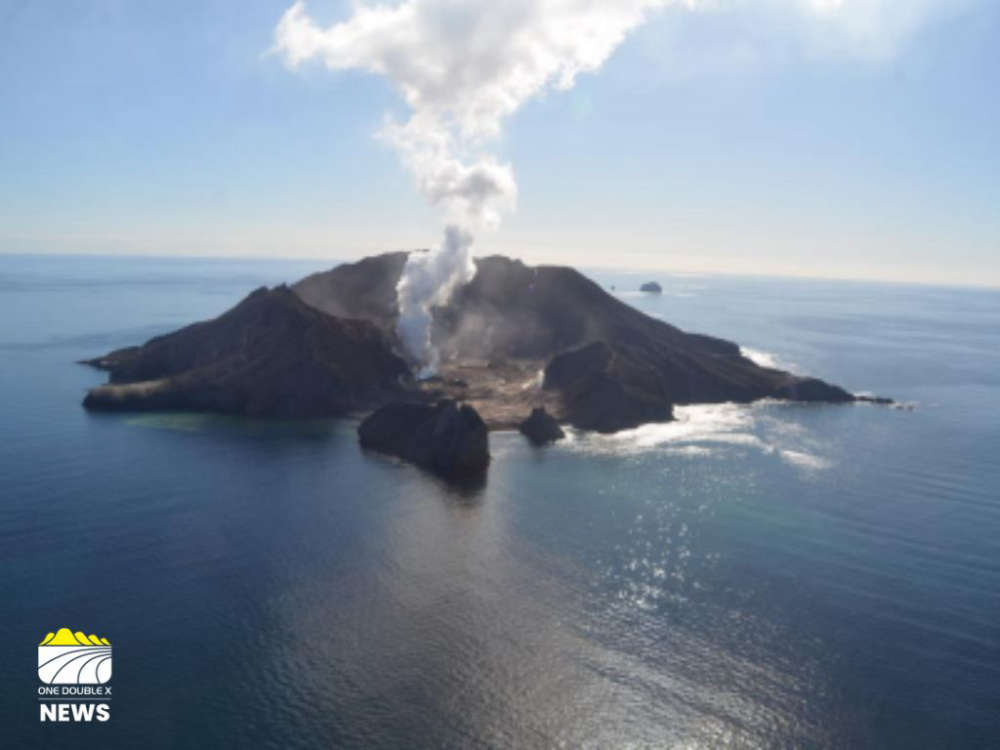
Whakaari/White Island is expected to continue producing small eruptions and ash emissions as a volcanic episode that began in May 2024 shows no signs of ending, according to Earth Sciences New Zealand.
The offshore Bay of Plenty volcano has been erupting intermittently for more than two years, with scientists describing the activity as part of a broader eruptive episode rather than isolated events.
In a new update, Earth Sciences New Zealand (ESNZ) said Whakaari remained New Zealand's most active volcano, frequently shifting between elevated unrest and minor eruptions.
"In May 2024, a new eruptive episode started, which has included elevated unrest and several weak eruptions," the agency said.
Scientists define eruptive episodes as "clusters of closely spaced eruptions that are linked by a common process, such as magma moving to shallower levels under the volcano".
According to monitoring data, magma rising closer to the surface has increased gas emissions and heat output, driving recent ash emissions and eruptions.
"The higher gas output and heat from the shallow magma is driving the recent eruptions and ash emission at Whakaari/White Island," ESNZ said.
During the current episode, the volcano's volcanic alert level has fluctuated between Level 2, indicating moderate-to-heightened unrest, and Level 3, indicating a minor volcanic eruption.
The agency said a lack of real-time monitoring equipment on the island limited its ability to assess lower levels of activity.
"For some time, our lack of real-time monitoring data from the island has meant that we can't distinguish between volcanic alert level 1 and 2."
As a result, "our monitoring group has fixed the alert level at Whakaari/White Island to a minimum of Level 2 until on-island monitoring is reinstated".
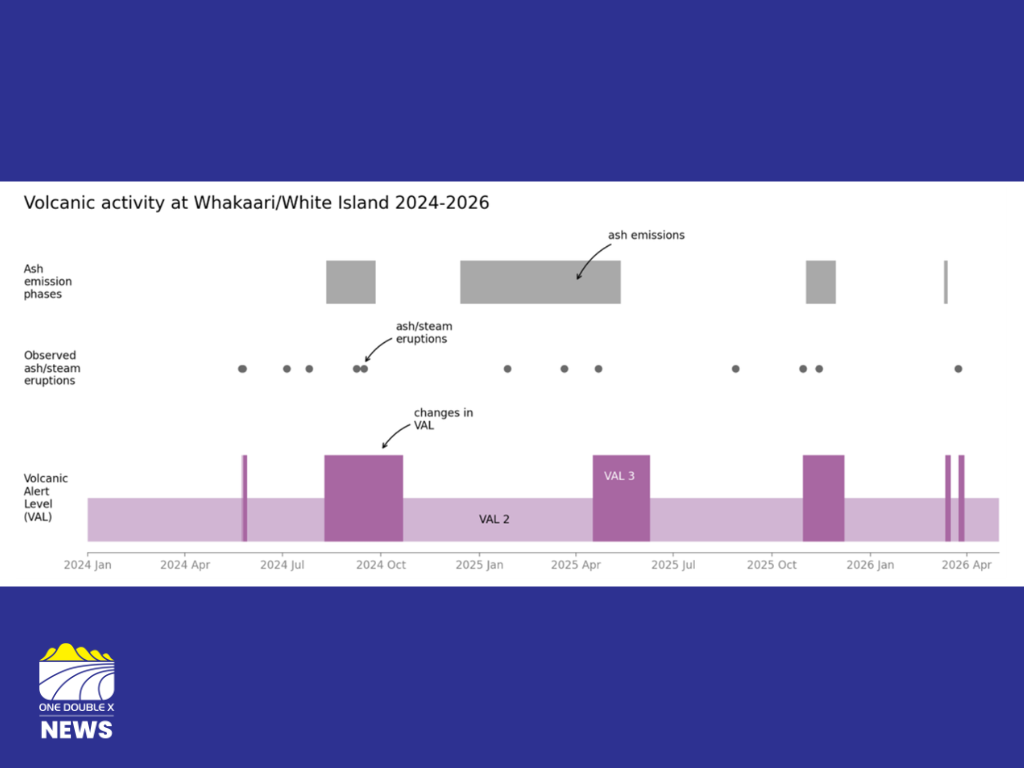
Volcanic activity at Whakaari/White Island since January 2024 showing Volcanic alert level, ash or steam eruptions, and ash emission phases. IMAGE // GeoNet
Whakaari sits about 50 kilometres offshore from Whakatāne and, despite several ash-producing eruptions, scientists said mainland impacts had been minimal.
"We've not seen any significant ash impacts on the mainland during this eruptive episode."
Ash emissions have, however, occasionally affected aviation.
ESNZ said it worked closely with the Volcanic Ash Advisory Centre, Civil Aviation Authority and Airways NZ to manage airborne hazards.
"Ash in the airspace near local airports from some of the recent activity has disrupted flights from time to time."
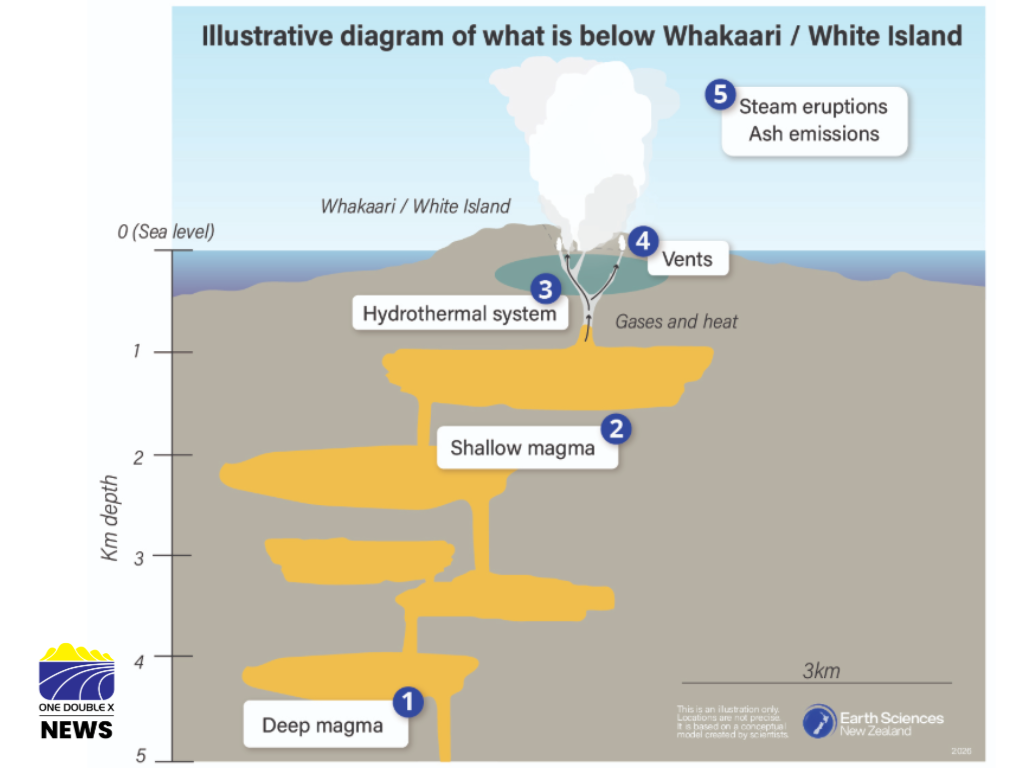
Simplified model of what’s below Whakaari/White Island volcano. Magma moves from depth (1) to shallower levels (2), and then gas, heat and ash pass through the hydrothermal system (3) and vents (4) and form a plume above the volcano (5). IMAGE // GeoNet
Research indicates the volcano is fed by a complex magma system, with deeper magma stored between 5km and 7km beneath the surface.
"Research tells us deep magma feeding the volcano is sitting about 5-7 km depth, and unrest or activity increases when some of this magma rises to shallower depths, less than 1km."
Scientists have observed increased gas emissions and temperatures since early 2024, using aircraft surveys, thermal imaging and satellite monitoring.
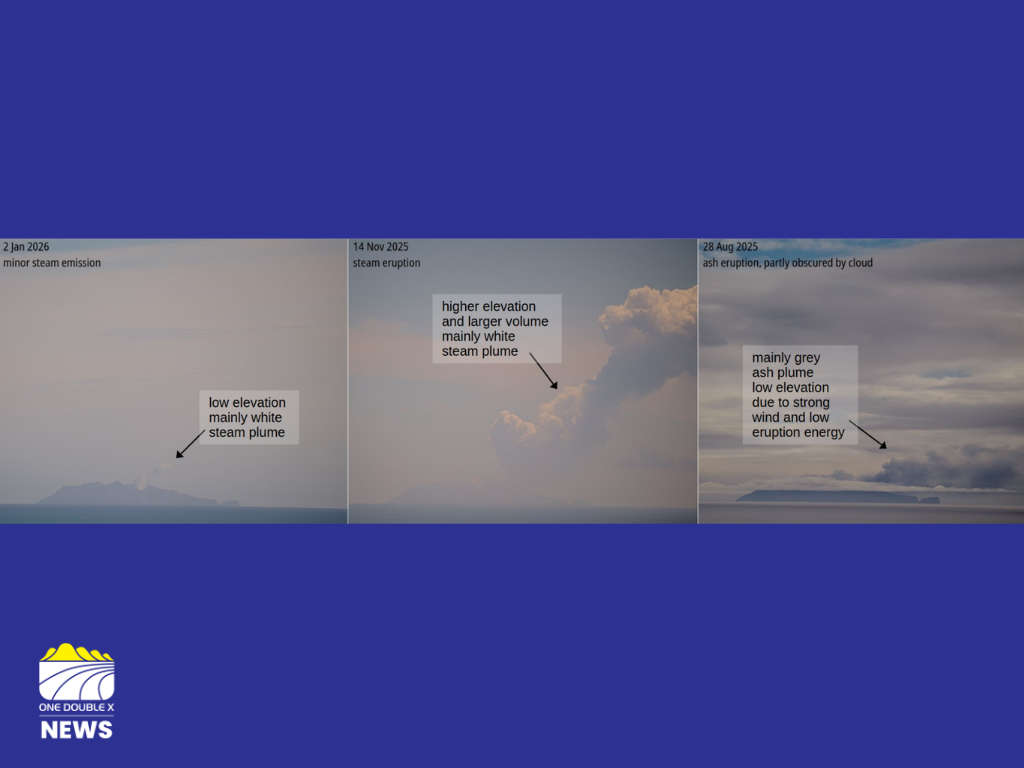
Different steam and ash plumes at Whakaari/White Island. IMAGE // GeoNet
Bay of Plenty residents are accustomed to seeing steam and gas plumes from the volcano, with ash emissions typically appearing darker and sometimes visible from the mainland.
ESNZ said the current level of activity was unlikely to have significant impacts beyond the island and nearby waters.
"The documented and oral history tells us that Whakaari/White Island is a frequently active volcano."
Historical records and new research suggest the volcano mostly produces relatively small eruptions.
"The volcano is highly active but mostly produces small eruptions that affect the island and nearby ocean, rather than impacting tens of kilometres from the volcano."
Based on both historical behaviour and current observations, scientists said the outlook was largely unchanged.
"Based on that history and current monitoring information, the volcano is likely to continue with this type and size of activity."
 Police Crack Down on New Gang Chapters in Ōpōtiki
 Under the House to the Try Line: Ruby and Her 11 Pups Seek Forever Homes
 Eastern Bay Local Government Future Left in Limbo After Head Start Decision Delayed
 Hillcrest Road Closures Scheduled for Friday