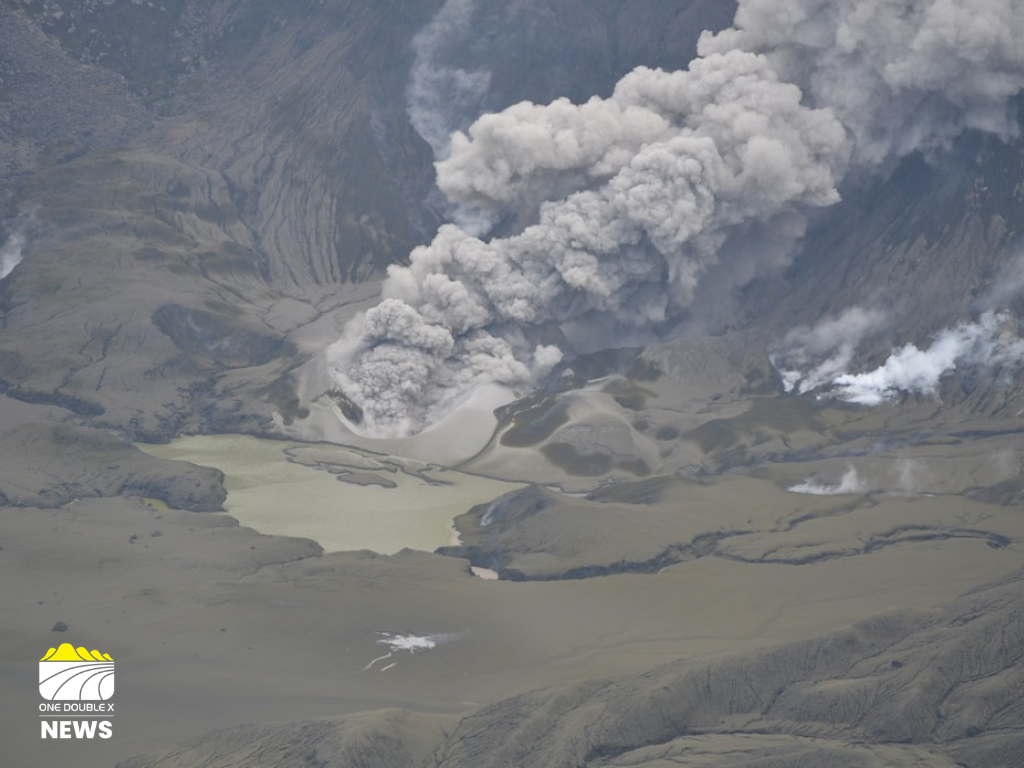
Minor eruptive activity continues at Whakaari/White Island, with scientists warning that more explosive eruptions could occur with little or no warning.
In its latest volcanic activity bulletin, Earth Sciences New Zealand (ESNZ) confirmed the volcanic alert level remains at level 3, while the aviation colour code stays at orange.
The volcano continues to produce low-altitude plumes of ash and gas that are carried downwind. At times, these plumes become more energetic, rising up to 1 to 1.5 kilometres above sea level.
Satellite observations indicate the plumes contain fine volcanic ash and sulphur dioxide, a gas commonly released during volcanic activity.
According to ESNZ, the volcano continues to generate “weakly-loaded volcanic ash and gas plumes that blow downwind”.
During northerly winds over the weekend, small amounts of volcanic gas and fine ash particles were carried towards the Bay of Plenty coastline.
Coastal residents may have noticed sulphur smells or a fine dusting of ash on their properties, ESNZ said.
It notes that “minor amounts of gas and fine ash particles were blown towards the Bay of Plenty coastline”, potentially resulting in sulphur odours and light ash deposits.
Although the current activity remains relatively passive and low-energy, scientists warn conditions could change rapidly.
“While the current activity is relatively passive and low energy, volcanic activity could still escalate with little or no warning,” ESNZ said.
Authorities warn that sudden, more explosive eruptions could send rocks, ash and dangerous surges of hot gas across the volcano’s main crater floor and into the immediate offshore area to the south-east of the island.
Such events could pose a major threat to life in those areas.
ESNZ warns that explosive eruptions could “throw rocks and ash and gas surges across the main crater floor and immediately offshore to the south-east of the island”.
Explosive activity could also produce ashfall in the immediate vicinity of Whakaari/White Island and create difficulties for aircraft and vessels operating nearby.
However, a significant impact on mainland New Zealand remains very unlikely.
“Any significant impact on the mainland remains very unlikely; the level of volcanic activity would have to escalate significantly for this likelihood to increase,” the agency said.
Any potential effects on aviation are being assessed and communicated by MetService’s Volcanic Ash Advisory Centre.
ESNZ said its ability to monitor Whakaari/White Island in near-real time remains very limited because of a lack of functioning monitoring instruments on the island.
It states that the agency’s ability to monitor the volcano “in near-real time remains very limited due to the lack of functioning instrumentation on the island”.
The Volcano Monitoring Group and the National Geohazards Monitoring Centre will continue observing the volcano using remote observations from the mainland, satellite data and occasional flights near the island. Additional information is also provided by MetService.
Members of the public are encouraged to follow guidance from Emergency Management Bay of Plenty, the National Emergency Management Agency and Health New Zealand regarding volcanic activity and exposure to volcanic emissions.
People who have witnessed activity at Whakaari/White Island are also encouraged to submit their observations, experiences and photographs through Earth Sciences New Zealand’s online Volcano Observation Report form.
The agency said public reports provide valuable information that supplements its monitoring capabilities and helps scientists assess the effects of the ongoing activity.
While the current eruption remains relatively low energy, authorities stress that conditions can change suddenly.
 Police Appeal for Information Following Kawerau Homicide
 Police Investigate Reported Assaults in Edgecumbe
 Eastern Bay of Plenty Enters Restricted Fire Season Ahead of Summer